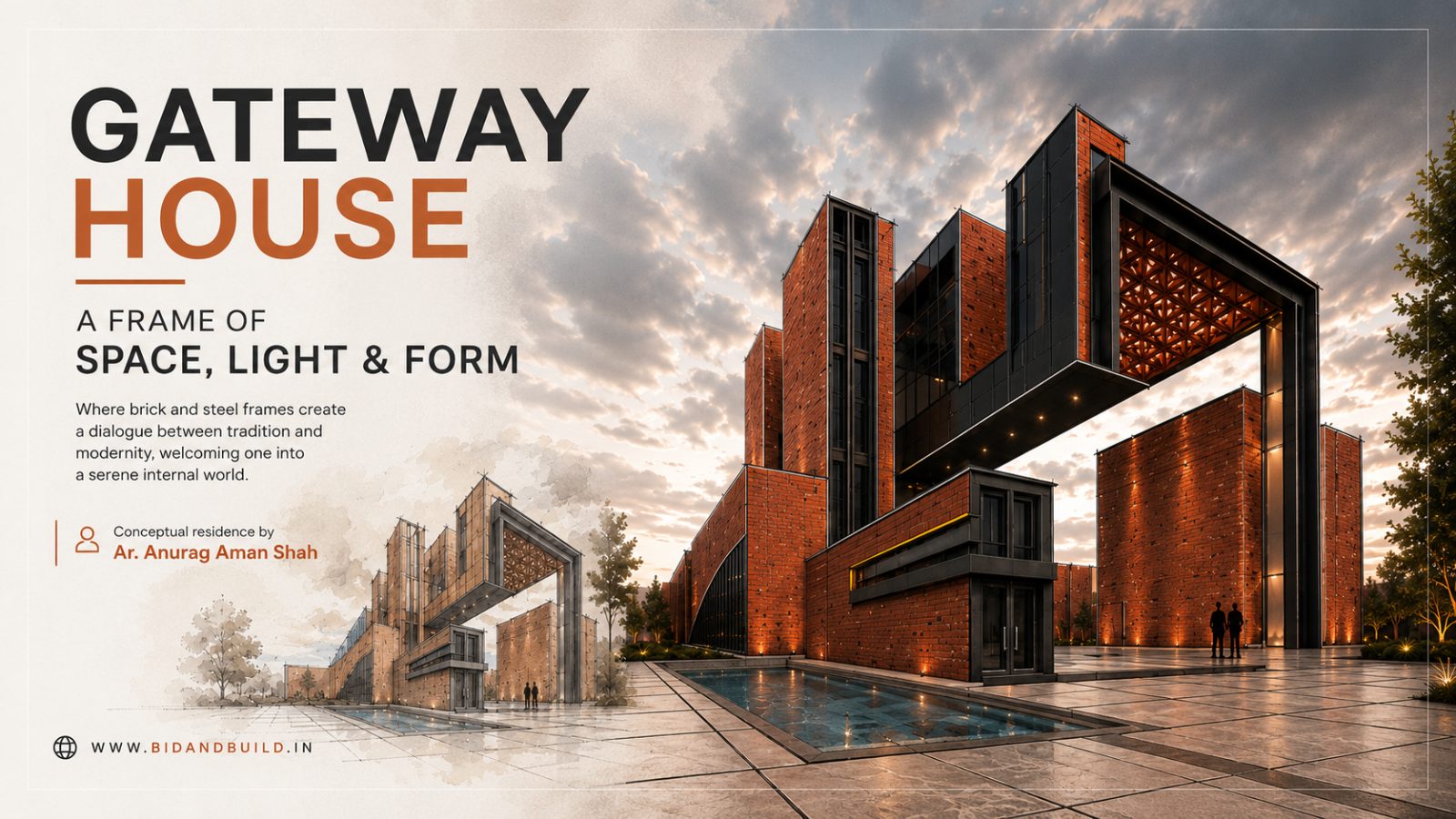
Most homes in Bihar are built without an architect. A contractor is hired, a draughtsman draws a floor plan, and construction begins. The result is structurally functional — and architecturally forgettable.
Gateway House is the counter-argument.
Designed by Ar. Anurag Aman Shah of Kalakaar Design Studios, Darbhanga — a graduate of MNIT Jaipur, one of India's top architecture schools — it is a G+2 conceptual residence that proves Bihar's climate, materials, and culture are not limitations on design quality. They are its greatest resource.
This article breaks down every major design decision — facade, structure, spatial planning, sustainability, and material specification — so you understand not just what was designed, but why. And what it means for anyone planning a home in Bihar today.
→ Book a free consultation with Ar. Anurag Aman Shah — verified on BidandBuild, 5.0/5 rating
What Is Gateway House?
Gateway House is a conceptual residential project designed in 2025 by Ar. Anurag Aman Shah of Kalakaar Design Studios for a 16,000 sq ft plot in Darbhanga, Bihar. The design concept — "A Frame of Space, Light & Form" — explores the architectural gateway as a threshold between the public world and the private one, using exposed brick, a dramatic MS steel frame, terracotta jaali screens, and internal courtyards as its primary architectural tools.
The project is fully detailed across seven design sheets covering concept, floor plans, elevations, sections, facade specifications, structural system, and sustainability strategy. It is not a sketch or a mood board. It is a constructable architectural proposal.
Detail SpecificationProject Name Gateway House — A Frame of Space, Light & Form
Architect Ar. Anurag Aman Shah, Kalakaar Design Studios
Qualification B.Arch, MNIT Jaipur · COA Registered
Location Darbhanga, Bihar
Plot Area 16,000 sq ft
Built-Up Area 7,500 sq ft
Floors G+2
Height 18 ft floor to floor · 28 ft to roof parapet
Estimated Build Cost ₹1.8 Cr – ₹2.5 Cr (excl. land)
Status Proposed / Conceptual
Why Darbhanga — and Why This Project Matters Right Now
Bihar is undergoing a residential construction boom. Plot registrations across Patna, Muzaffarpur, Darbhanga, and Samastipur have risen sharply since 2023. A growing professional and business-owning class is building homes for the first time — and most of them are doing it without design guidance.
The result is a built environment that is improving in scale but not in quality. Bigger homes. More floors. The same generic facades.
Ar. Anurag Aman Shah's practice is a direct response to this gap. Based in Darbhanga — not Patna, not Delhi — he is building a design practice in the heart of the region that needs it most. Gateway House is a demonstration of what that practice is capable of when given a blank canvas.
"Good architecture is not created by adding complexity. It is created by refining one strong idea until every space, every material, and every detail contributes to a meaningful experience."
— Ar. Anurag Aman Shah, Founder, Kalakaar Design Studios
This is also what great architecture in India has always done — find the genius of a place and amplify it.
The Design Concept: Gateway as Threshold
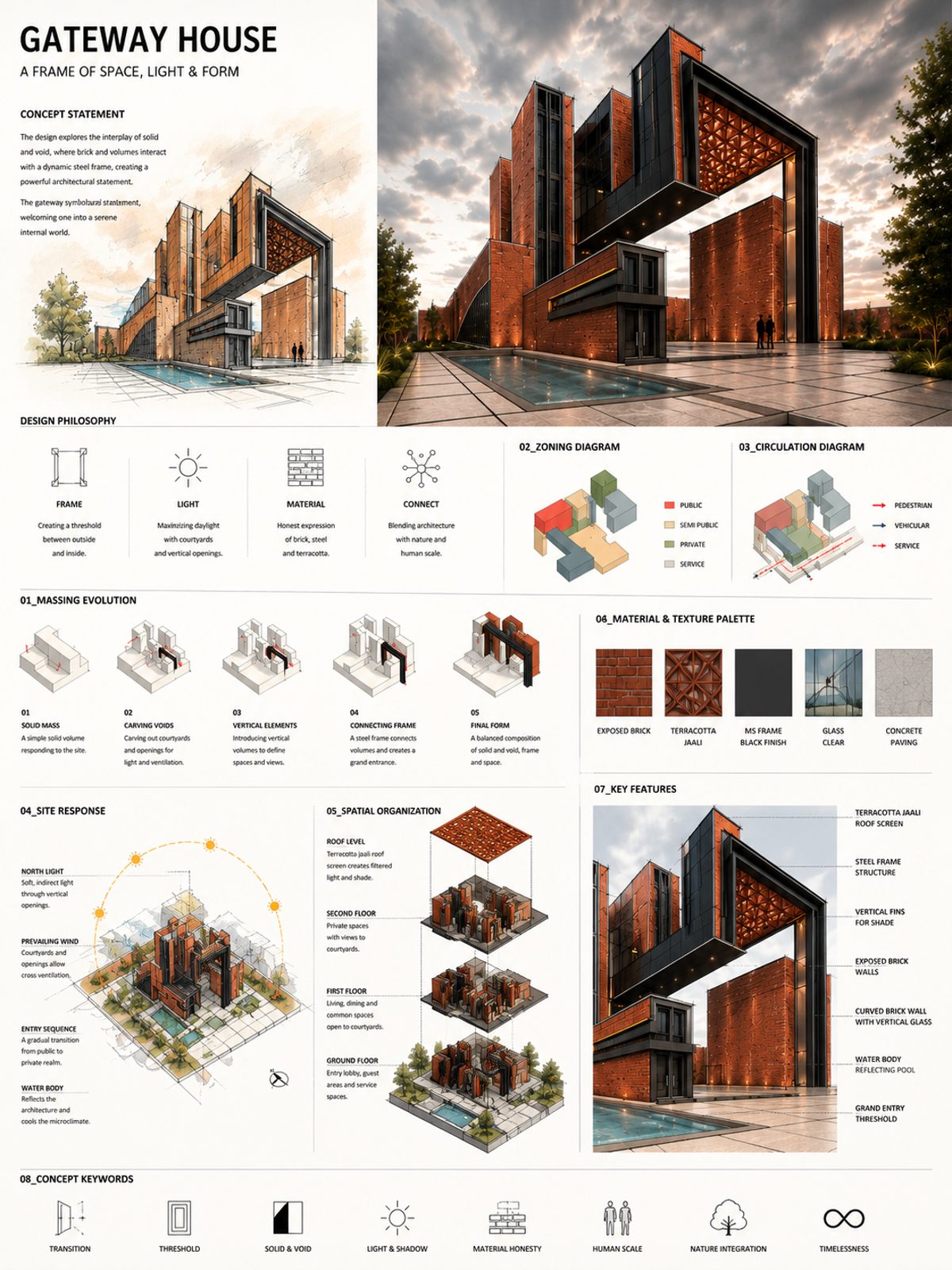
Concept, plans, sections, and sustainability strategy — Gateway House, Darbhanga.
"Architecture should speak of its time and place, but yearn for timelessness."
— Tadao Ando
The design begins with one question: what does it feel like to arrive at a home?
Not open a gate. Not park a car. Arrive. To experience a transition from the noise and heat of the street into a world of calm, shade, and spatial intention.
The gateway frame is the architectural answer. A steel structure rises above the roofline — taller than it needs to be structurally, exactly as tall as it needs to be spatially. It creates a threshold. You do not walk into this house. You pass through it.
The concept unfolds through five interlocking principles:
Design Principle What It DoesSolid & Void Brick masses and open courtyards in constant spatial tension
Frame & Structure The MS steel frame defines space, not just supports it
Light & Shadow Jaali screens and vertical fins sculpt light across the day
Nature & Serenity Courtyards bring air, water, and greenery into every level
Experience & Journey Architecture that reveals itself as you move through it
These are not stylistic preferences. They are rules the architect set before drawing a single line — and held to consistently across every sheet.
The Massing: How the Form Was Arrived At
Most residential projects in Bihar begin with a floor plan and add a facade. Gateway House worked in the opposite direction — starting with a massing study and working inward.
The massing evolution shows five stages:
01 — Solid Mass. A simple rectangular volume responding to the plot.
02 — Carving Voids. Courtyards cut into the mass for light and ventilation.
03 — Vertical Elements. Towers and vertical volumes introduced to define spatial hierarchy.
04 — Connecting Frame. The steel gateway frame added to connect volumes and create arrival.
05 — Final Form. A balanced composition of solid, void, frame, and space.
This sequence matters because it shows the discipline behind the design. Nothing in the final form is arbitrary. Every element was earned through a process of reduction and refinement — the opposite of decoration.
The Gateway Frame: Structural and Symbolic
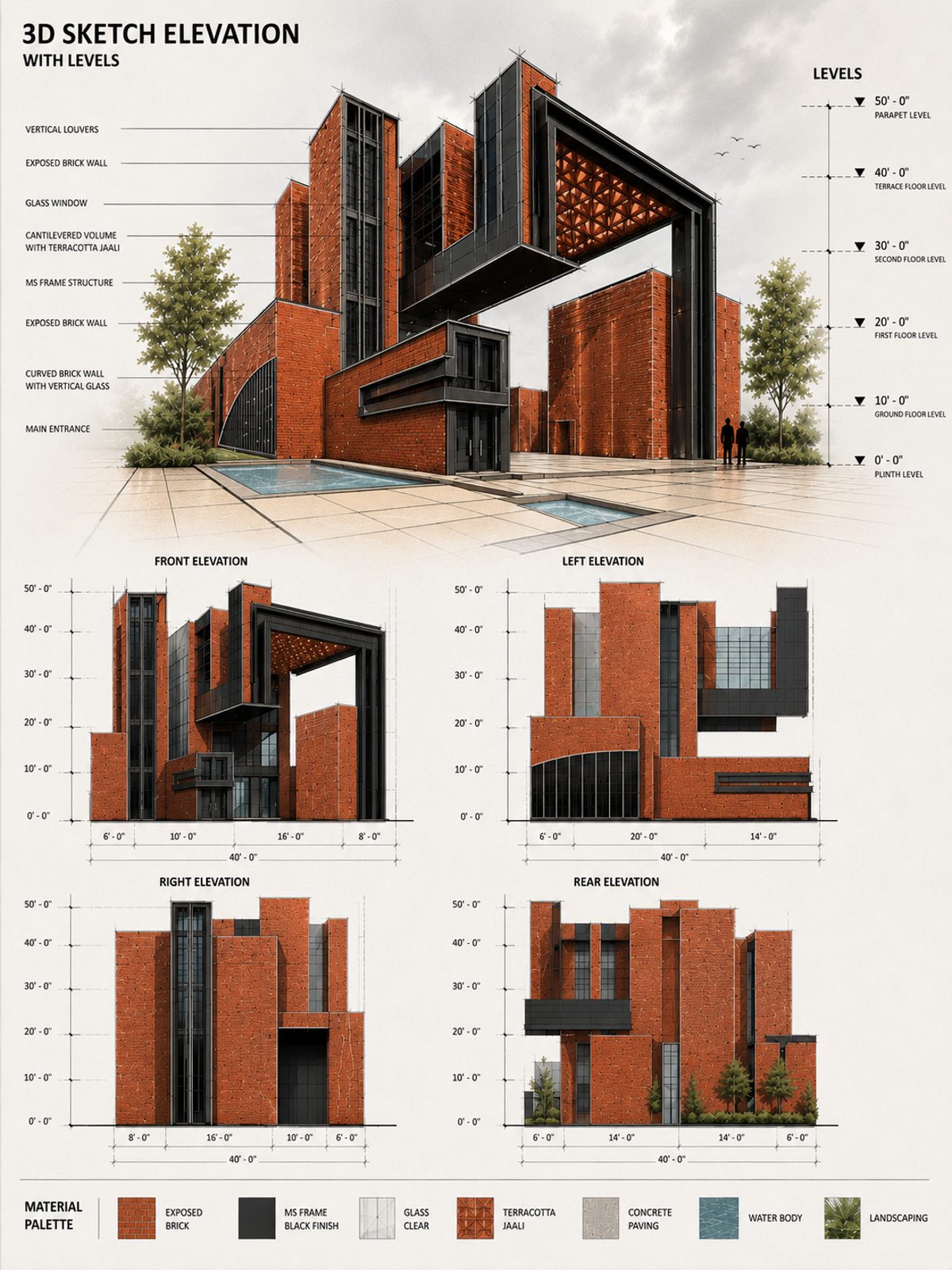
Front, left, right, and rear elevations with level markers — Gateway House. Parapet at 50 ft, terrace at 40 ft, second floor at 30 ft.
The MS steel box frame — 200×200×8mm sections, powder-coated black — rises from plinth level to the roof parapet, framing the main entrance and the terracotta jaali screen above it.
It is simultaneously structural and symbolic.
Structurally: it carries the roof screen load, stabilises the cantilevered volumes, and defines the primary vertical organisation of the facade.
Symbolically: it announces the home from the street. It creates an identity. In a neighbourhood of similar-looking buildings, this house has a face that is unmistakably its own.
The frame costs more than a standard RCC parapet. The premium is the identity. For a home that will stand for 40–60 years, that is not an indulgence — it is a long-term investment in architectural character.
"Good architecture is not created by adding complexity. It is created by refining one strong idea until every space, every material, and every detail contributes to a meaningful experience."
— Ar. Anurag Aman Shah
Homeowner insight: Ask your architect specifically — what gives my home its identity from the street? If the answer is paint colour or tile pattern, you need a deeper conversation about facade design before construction begins. Read: how to hire an architect in India the right way
Exposed Brick: Bihar's Best Building Material, Finally Used Well
The primary material is 230mm exposed brick with recessed mortar joints throughout.
This is not a budget compromise. It is the most intelligent material choice available in Bihar — used here at its full architectural potential.
Three reasons this works:
1.Thermal mass. 230mm of brick absorbs daytime heat and releases it slowly at night, naturally moderating interior temperatures. In Darbhanga's climate — summer peaks above 42°C, cool dry winters — this is climate-appropriate construction, not a stylistic choice.
2.Craft honesty. Bihar has exceptional brick masonry traditions. Recessed joints require skill — a mason who can hold consistent depth and line across an entire facade. This design celebrates that craft rather than hiding it behind plaster.
3.Lifecycle cost. Exposed brick eliminates plastering, painting, and the recurring maintenance cost of exterior paint in a high-humidity monsoon environment. Upfront material cost is similar to standard brick plus plaster. Lifecycle cost is significantly lower.
Homeowner insight: If your plot is in Bihar, Rajasthan, or Madhya Pradesh — states with strong brick masonry traditions — exposed brick is one of the most cost-effective and beautiful facade choices available. Most homeowners never consider it because their contractor defaults to plaster. Ask explicitly.
Terracotta Jaali: The One Element That Does Everything
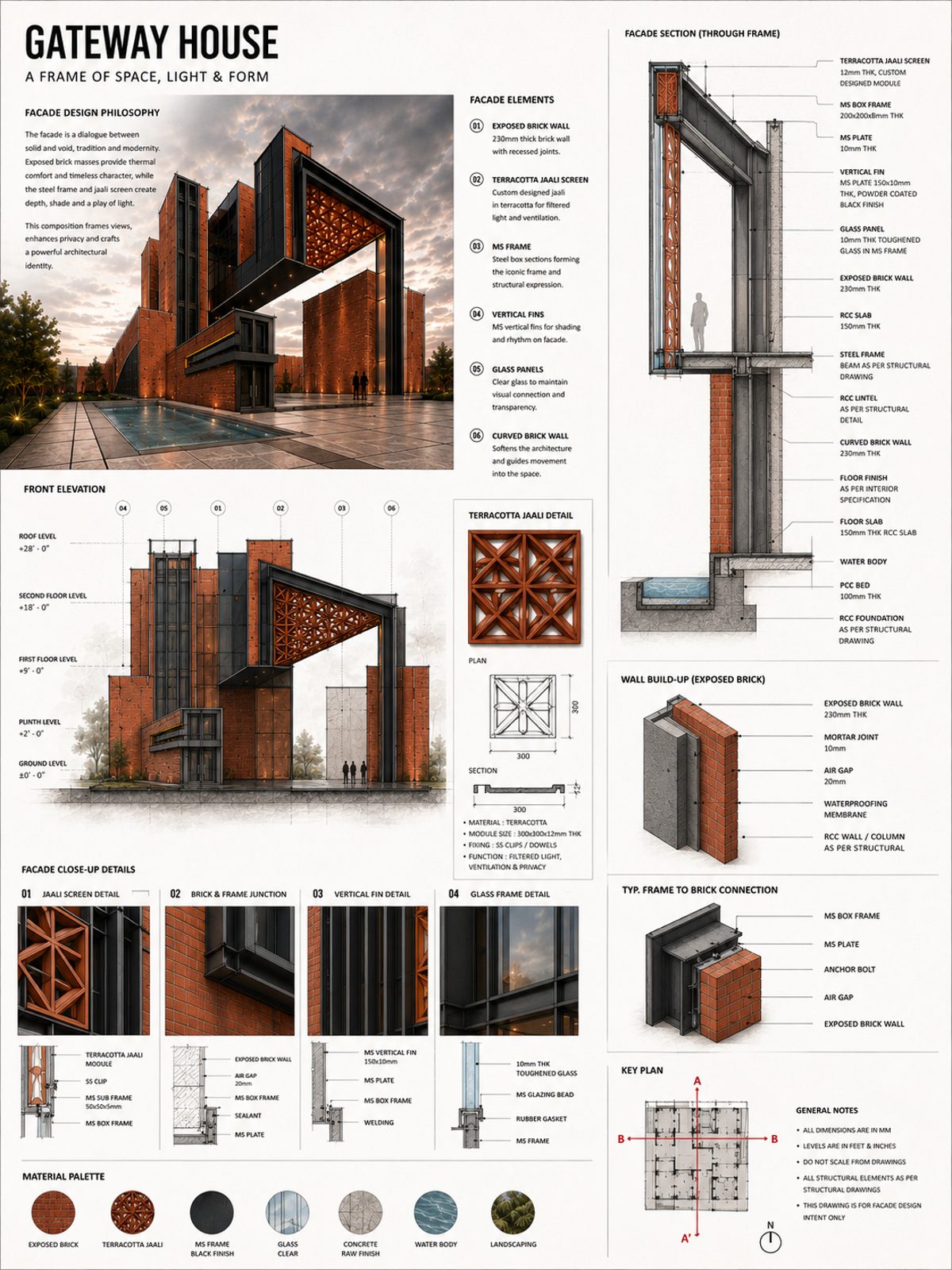
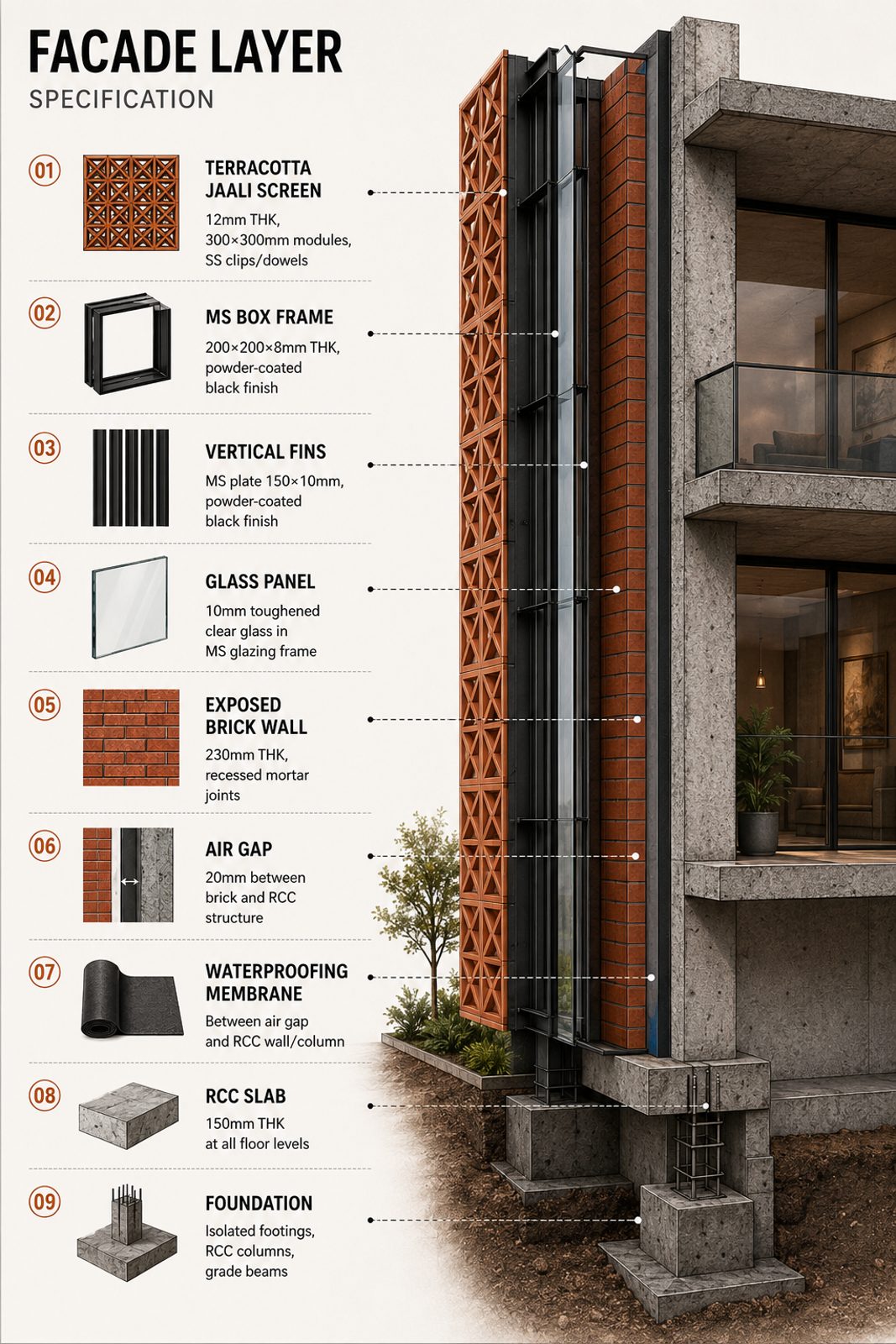
Facade section through the MS frame, terracotta jaali module detail (300×300×12mm), and wall build-up specification — Gateway House.
The custom terracotta jaali screen — 300×300×12mm modules, fixed with SS clips and dowels — is the most architecturally layered element in the project.
It solves four problems simultaneously:
Problem How the Jaali Solves It
- Solar heat gain Filters direct sunlight before it reaches glass or interior surfaces
- Privacy Creates visual opacity from outside while maintaining views from inside
- Ventilation Open module geometry allows air movement at roof and facade level
- Aesthetics Creates shifting light-and-shadow patterns across interiors through the day
No single conventional building element — glass, aluminium louver, concrete fin — does all four. The jaali does.
The cultural dimension is equally significant. Terracotta jaali connects this building to a tradition spanning Mughal screens, Rajput havelis, and Bengali terracotta temples — all solving the same problem, in the same climate zone, using the same material. Ar. Anurag Aman Shah is not quoting history. He is continuing it.
This is also deeply aligned with Vastu Shastra's principle of the transitional threshold — the zone between outside and inside where Indian architecture has always placed its greatest intention. The jaali is that threshold made physical and beautiful.
Homeowner insight: Terracotta jaali costs ₹350–₹600 per sq ft installed — significantly less than imported cladding systems, and more thermally effective than glass facades in North Indian climates. If your home has a west-facing wall or a roof terrace parapet, jaali deserves serious consideration.
Courtyards: The Passive Cooling System Inside the Floor Plan
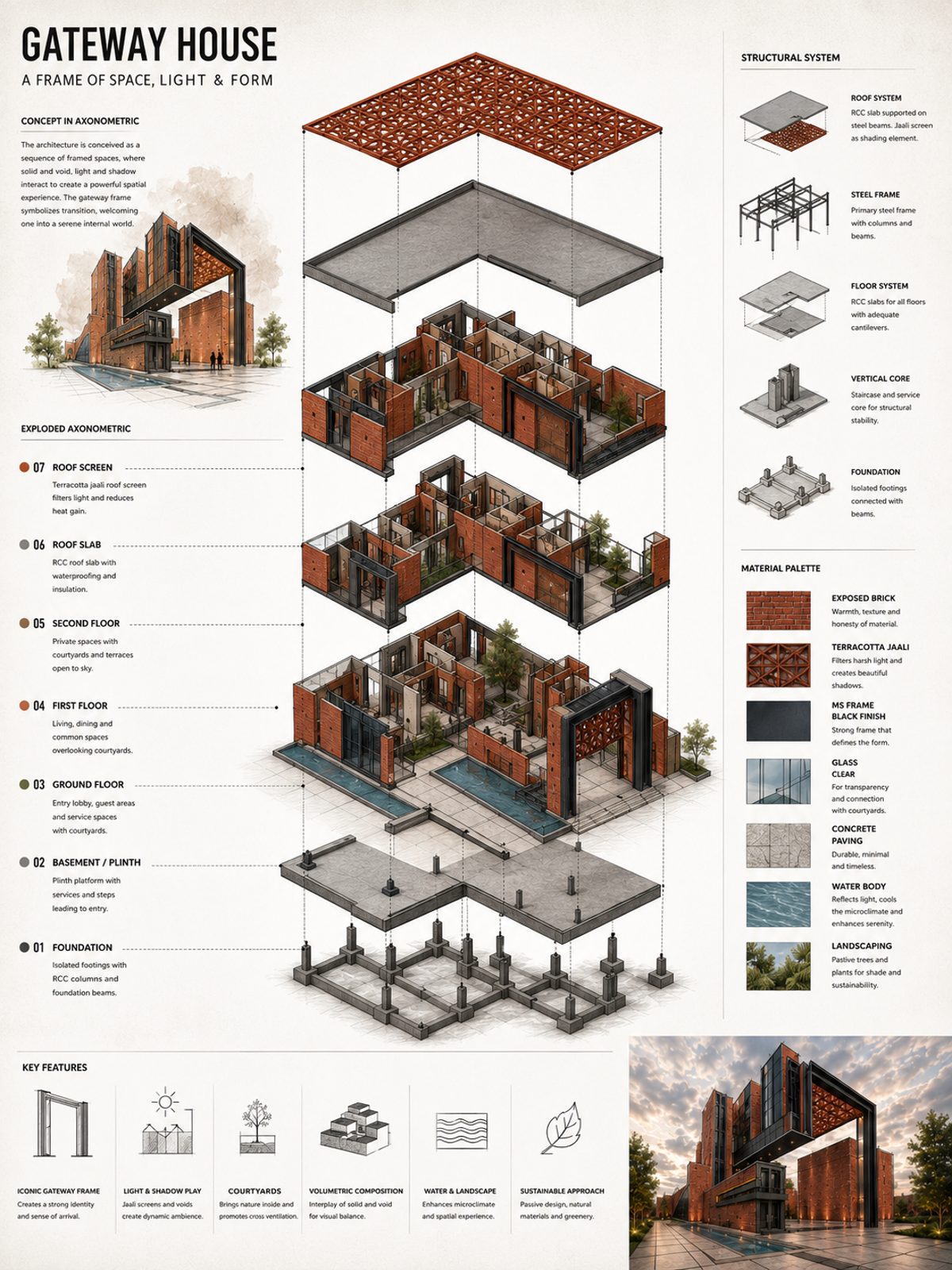
Exploded axonometric — roof screen, second floor, first floor, ground floor, plinth, and foundation levels. Gateway House, Darbhanga.
Every floor of Gateway House opens onto a courtyard.
This is the most important spatial decision in the entire project — and the one most homeowners in Bihar are not making.
Here is what courtyards actually deliver, in measurable terms:
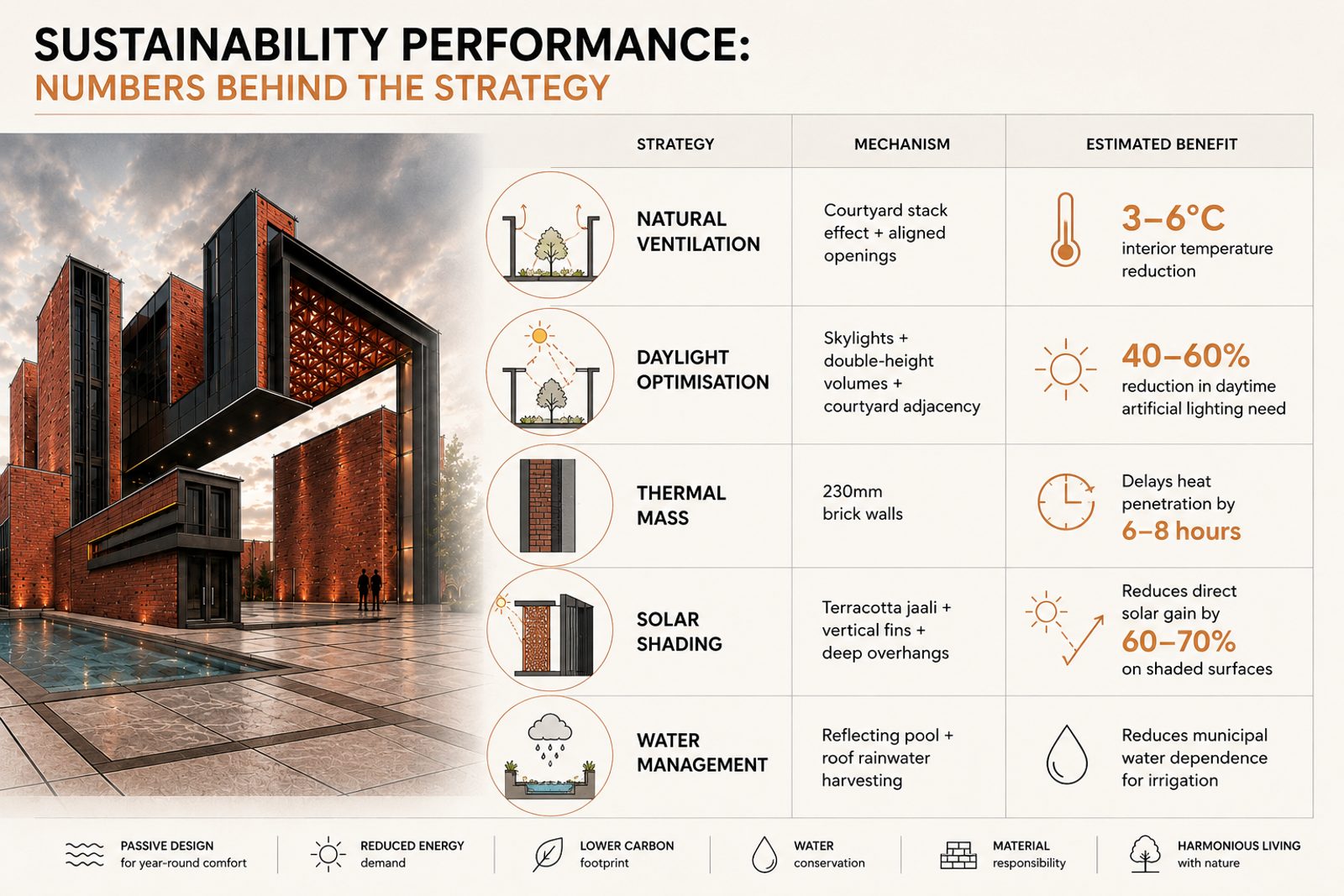
- Temperature reduction: Internal courtyards reduce ambient interior temperature by 3–6°C through stack-effect ventilation — hot air rises through the courtyard volume, drawing cooler air in at lower levels. In a Darbhanga summer, that is the difference between a liveable home and an unbearable one.
- Daylight: Every room adjacent to a courtyard receives natural light on two sides — from the courtyard and from the outer wall. No room is dark. No room needs artificial light during the day.
- Well-being: Homes with internal greenery and sky visibility consistently score higher on occupant well-being than sealed, air-conditioned equivalents. The courtyard is a quality-of-life investment, not a decorative feature.
The reflecting pool along the entry axis adds a further layer — evaporative cooling at the most heat-exposed point of the site, the main approach from the street.
Homeowner insight: On a plot of 1,500 sq ft or more, a 6×8 ft internal courtyard is achievable without significant sacrifice of built area. Discuss with your architect before finalising the floor plan — once the structure is up, adding a courtyard is prohibitively expensive.
The Sections: What the Building Feels Like From Inside
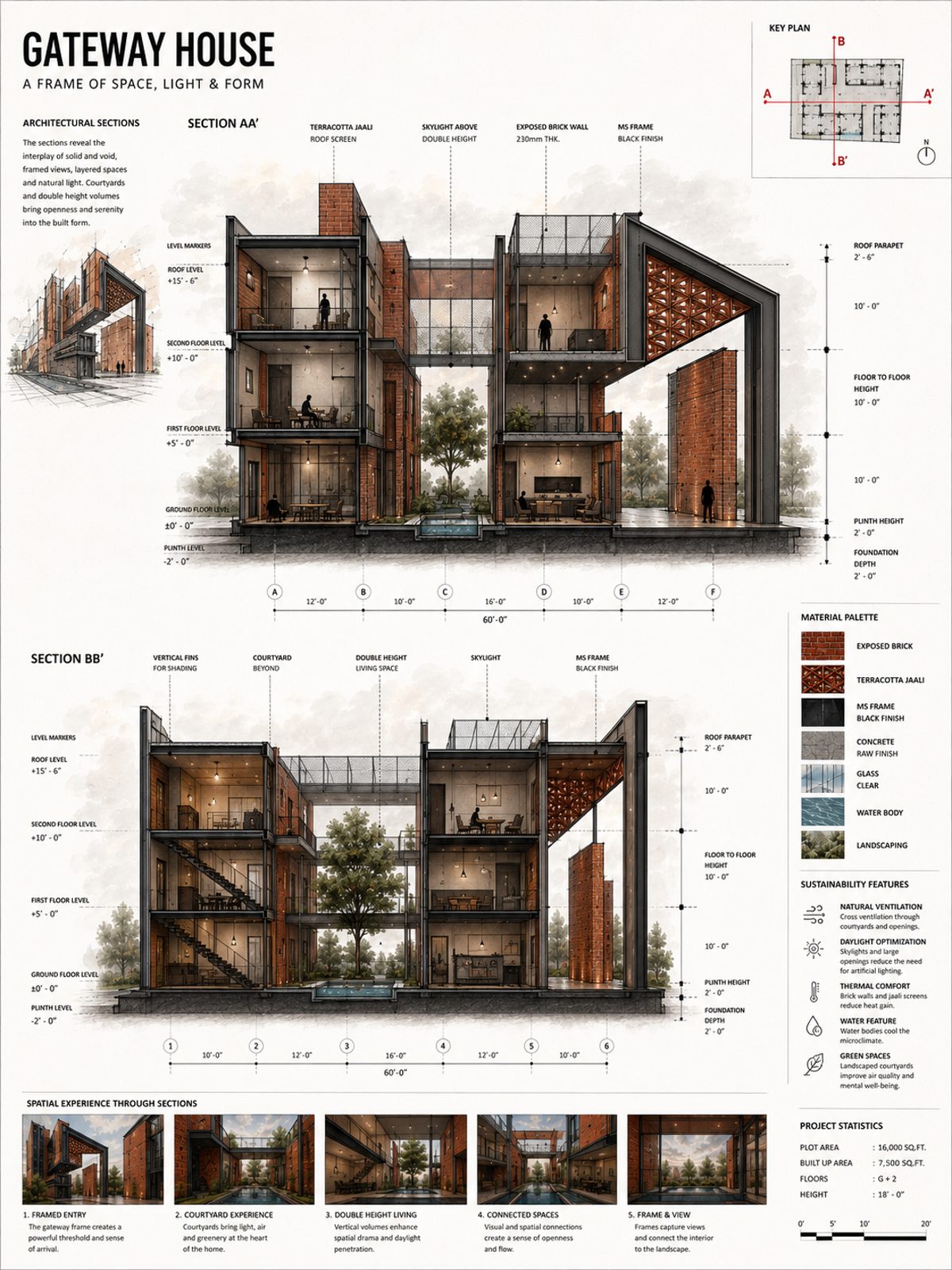
Section AA' and Section BB' — double-height living volumes, courtyard depths, terracotta jaali roof screen, and floor-to-floor heights. Gateway House.
Material & Façade Palette
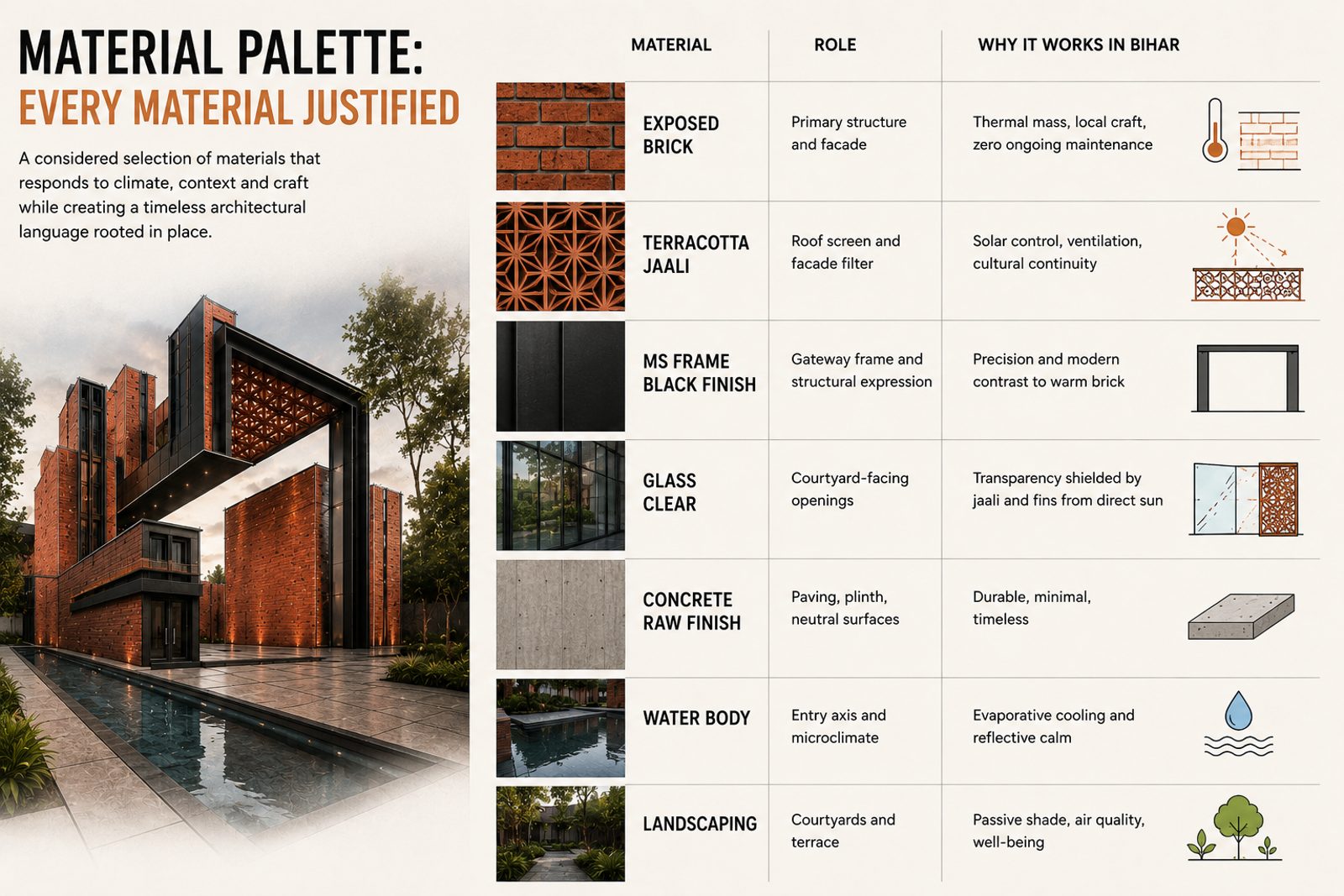
 The project combines exposed brick, steel, terracotta jaali, glass, and concrete to create a durable, climate-responsive, and visually cohesive architectural language
Elevations show what a building looks like. Sections reveal what it feels like to be inside.
Floor-to-floor height: 10 feet consistently across all levels.
In Bihar, where most residential construction uses 9 ft to save on brick, concrete, and steel, this is a deliberate spatial investment — approximately ₹80,000–₹1,20,000 additional cost per floor on a 1,500 sq ft footprint. The spatial return is a home that feels generous, not compressed.
The sections reveal four things the elevations cannot show:
Double-height living volumes — rooms that feel larger than their plan dimensions because the ceiling rises to 20 ft above the living area.
Skylights pulling daylight deep into the plan at points where windows cannot reach.
Terracotta jaali roof screen creating a filtered light layer at the very top of the building — so the uppermost floor receives neither harsh direct sunlight nor complete shade.
Courtyards visible from three levels simultaneously — ground, first, and second floor all share the same sky.
This is a building designed from the inside out.
Floor Plans: Spatial Organisation by Level
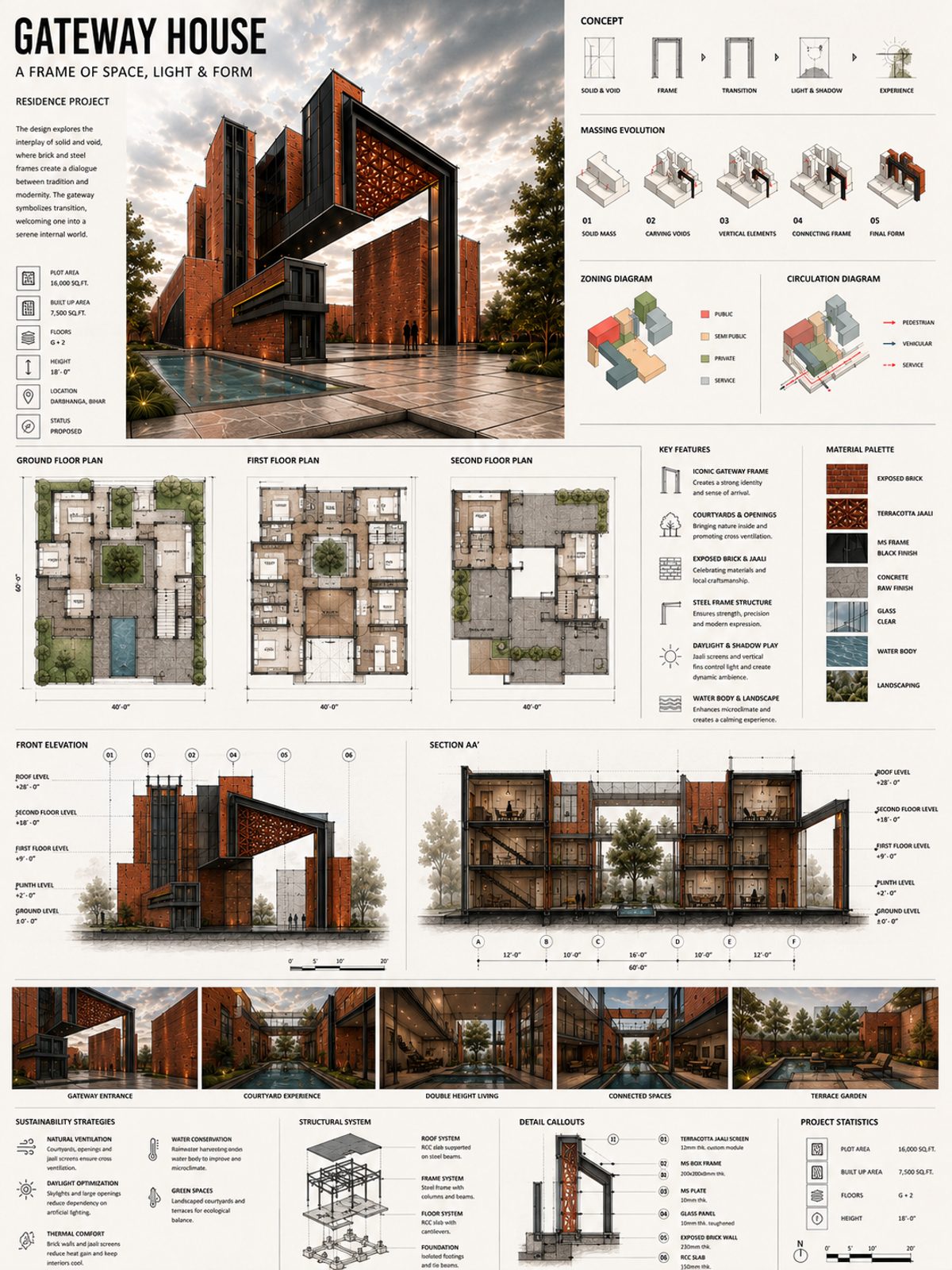
Ground, first, and second floor plans — Gateway House. 16,000 sq ft plot, 7,500 sq ft BUA, G+2, Darbhanga, Bihar.
The organisational logic is clear : Public at the base, private at the top, nature at the centre of every level.
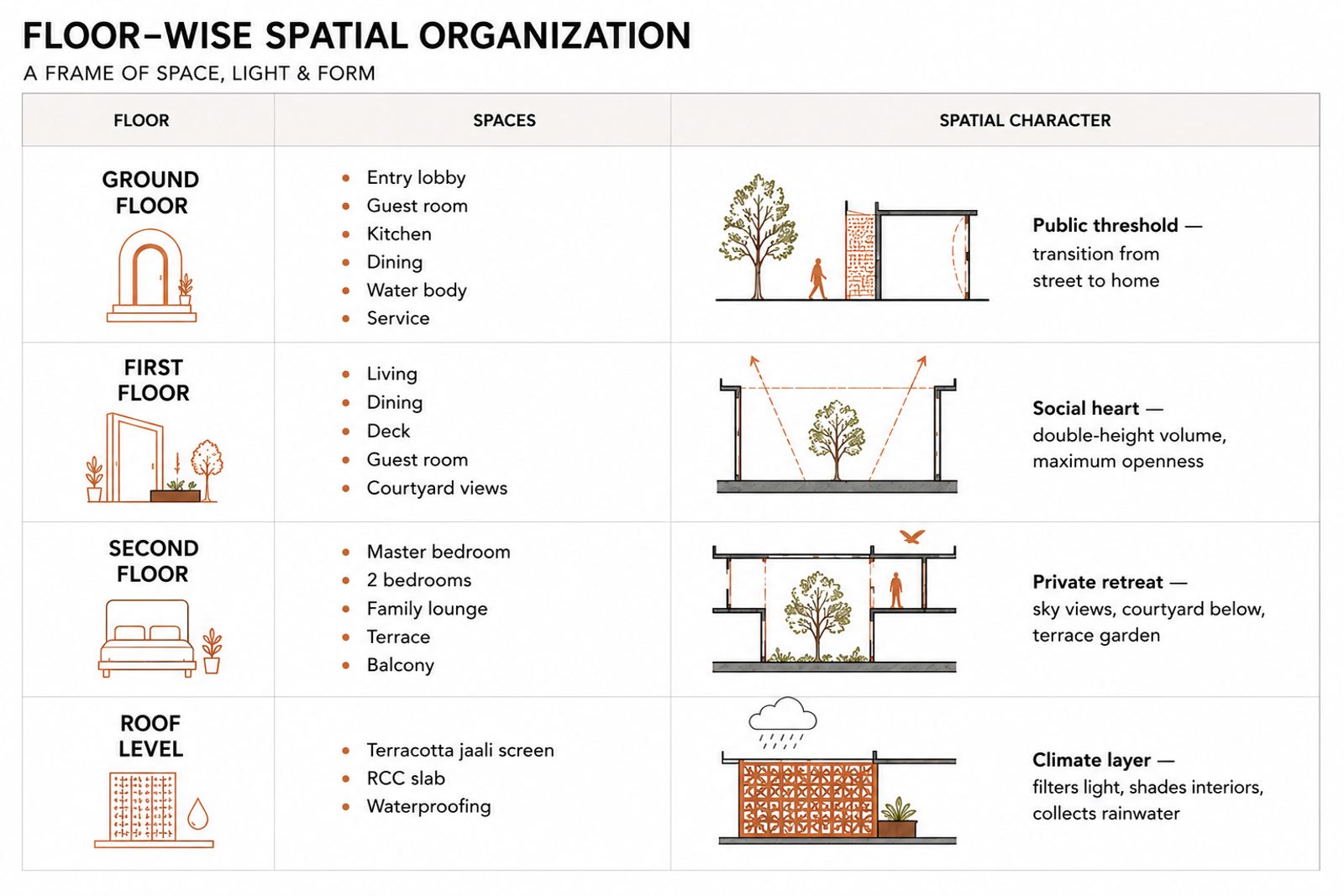
The ground floor is the most spatially generous — wide entry threshold, water body visible on arrival, service spaces clearly separated from guest zones. The second floor is the most private — bedrooms oriented away from street noise, family lounge facing the courtyard, terrace garden creating a planted sky room above the city.
For more on thinking through floor plan organisation before briefing an architect: How to Build a House in India — Complete Step-by-Step Guide 2026
Full Facade Specification
The difference between a concept and a building is this level of detail. Gateway House has it. A contractor with this specification sheet can price it. A structural engineer can calculate it. A site supervisor can build it.
Facade Layer Specification
- Terracotta Jaali Screen12mm THK, 300×300mm modules, SS clips/dowels
- MS Box Frame 200×200×8mm THK, powder-coated black finish
- Vertical Fins MS plate 150×10mm, powder-coated black
- Glass Panel 10mm toughened clear glass in MS glazing frame
- Air Gap 20mm between brick and RCC structure
- RCC Slab 150mm THK at all floor levels
- Floor Finish As per interior specification
- Exposed Brick Wall 230mm THK, recessed mortar joints
- Foundation Isolated footings, RCC columns, grade beams
- Waterproofing Membrane Between air gap and RCC wall/column
Material Palette: Every Material Justified
Sustainability Performance: Numbers Behind the Strategy
What This Project Teaches Every Bihar Homeowner
Gateway House is a conceptual project. But its value is not only as a building — it is as a demonstration of a design methodology that any homeowner can demand for their own project.
Five questions it teaches you to ask:
1. What is my home's arrival sequence?
The transition from street to entrance is an architectural experience. It can be designed or left to chance. Ask your architect: how does someone arrive at my home?2. Is natural light designed in from day one?
Not windows added to completed rooms — but rooms organised around light sources. Every room in Gateway House receives natural light from at least two directions.3. Are the materials specific to where I am building?
Brick, terracotta, Kota stone, and lime plaster are Bihar and Rajasthan's strongest building materials. Ask your architect: why this material, for this climate, on this site?4. Does my floor plan have a spatial centre?
A courtyard, a double-height volume, a garden — something that gives the home an identity beyond the sum of its rooms. Most contractor-drawn floor plans do not have one. Gateway House has three.5. Is my design sustainable without the label?
Passive cooling, natural light, cross-ventilation, and rainwater management do not require a green certification. They require a thoughtful architect. Gateway House achieves all five without mechanical sustainability systems.If your architect cannot engage with these questions, find one who can: How to Hire an Architect, Contractor or Interior Designer in India
Planning a home in Bihar?
Ar. Anurag Aman Shah brings MNIT Jaipur training and Bihar-specific practice to every project. Rated 5.0/5 across 11 verified reviews on BidandBuild. Free first consultation.
→ View profile and book your consultation
How Much Would Gateway House Cost to Build?
At Bihar's 2026 construction rates, a 7,500 sq ft G+2 residence of this specification breaks down as follows:
Cost Component Estimated Range- Base Construction (₹1,600–₹2,800/sq ft) ₹1.2 Cr – ₹2 Cr
- MS Steel Frame (gateway + roof structure) ₹12 – ₹18 Lakhs
- Terracotta Jaali Screens ₹8 – ₹14 Lakhs
- Water Body + Landscaping ₹10 – ₹20 Lakhs
- Architect + Structural Engineering Fees ₹8 – ₹15 Lakhs
- Interior Fit-Out (mid-range) ₹25 – ₹40 Lakhs
- Government Approvals + Utility Connections ₹3 – ₹6 Lakhs
This is a premium residence. But the design principles it demonstrates — courtyards, exposed brick, passive ventilation, honest materials — are applicable at any budget. A ₹40 lakh home in Muzaffarpur can incorporate a courtyard, exposed brick, and one strong facade element. The scale changes. The thinking does not.
For construction cost benchmarks: House Construction Cost in Patna Per Sq Ft 2026
For duplex-specific budgeting: Can You Build a Duplex Under ₹40 Lakhs in India?
About Ar. Anurag Aman Shah

Ar. Anurag Aman Shah — Founder, Kalakaar Design Studios, Darbhanga.
Ar. Anurag Aman Shah
Founder, Kalakaar Design Studios · B.Arch, MNIT Jaipur · COA Registered
Based in Darbhanga, Bihar, Ar. Anurag Aman Shah leads Kalakaar Design Studios — a practice focused on contemporary residential architecture, interiors, landscape design, and execution. His work is guided by three consistent principles: simplicity, climate-responsive planning, and honest material expression.
He holds a Bachelor of Architecture from MNIT Jaipur — one of India's premier schools of architecture — and is registered with the Council of Architecture (COA) of India. Projects are undertaken across India, with deep roots in Bihar's residential and commercial market.
He is verified on BidandBuild with a 5.0/5 rating across 11 verified reviews.
Gateway House represents his design thinking at full creative latitude. Every project the studio takes on — at any scale or budget — is held to the same standard: one strong idea, refined until every detail earns its place.
"Good architecture is not created by adding complexity. It is created by refining one strong idea until every space, every material, and every detail contributes to a meaningful experience."
— Ar. Anurag Aman Shah
Architects looking to grow their practice: How Architects Can Get More Clients in India 2026
Frequently Asked Questions
1. What is Gateway House?
Gateway House is a conceptual G+2 residential project designed by Ar. Anurag Aman Shah of Kalakaar Design Studios for a 16,000 sq ft plot in Darbhanga, Bihar. The design concept — "A Frame of Space, Light & Form" — explores the architectural gateway as a spatial threshold using exposed brick, an MS steel frame, terracotta jaali screens, and internal courtyards as its primary tools.2. Who designed Gateway House?
Ar. Anurag Aman Shah, founder of Kalakaar Design Studios, Darbhanga, Bihar. B.Arch graduate from MNIT Jaipur, COA-registered, and verified on BidandBuild with a 5.0/5 rating across 11 reviews.3. What materials are used in Gateway House?
Primary materials are 230mm exposed brick, 200×200×8mm MS box frame with black powder-coat, custom 300×300×12mm terracotta jaali modules, 10mm toughened clear glass, concrete raw finish paving, water body, and landscaping. All locally available in Bihar and Rajasthan.4. How does Gateway House handle Bihar's climate?
Through five passive strategies: 230mm brick walls for thermal mass, terracotta jaali screens reducing solar heat gain by 60–70% on shaded surfaces, internal courtyards delivering 3–6°C temperature reduction through stack-effect ventilation, a reflecting pool for evaporative cooling, and vertical fins with deep overhangs for shading.5. How much would Gateway House cost to build?
Estimated total project cost excluding land is ₹1.7–₹3.0 crore, including construction, MS steel frame, terracotta jaali, water body, landscaping, architect fees, interiors, and government approvals. Base construction alone at Bihar rates (₹1,600–₹2,800/sq ft) is ₹1.2–₹2.1 crore for 7,500 sq ft.6. What is terracotta jaali and why is it used here?
Terracotta jaali is a perforated screen made from fired clay modules — here 300×300×12mm — fixed to the facade or roof structure. It filters direct sunlight, allows air movement, provides visual privacy from outside while maintaining views from inside, and creates dynamic light-and-shadow patterns across interiors. It costs ₹350–₹600/sq ft installed and outperforms glass facades thermally in North Indian climates.7. Can Ar. Anurag Aman Shah design a home outside Darbhanga?
Yes. Kalakaar Design Studios serves clients across Bihar — Patna, Gaya, Muzaffarpur, Samastipur, Bhagalpur, Jehanabad — and pan-India. Remote consultations are available via BidandBuild.8. What is BidandBuild?
BidandBuild is India's construction marketplace connecting homeowners with verified architects, contractors, and interior designers — completely free, zero commission. Learn more about BidandBuild.Build something that matters.
BidandBuild connects Bihar homeowners with verified, design-led architects — from Patna to Darbhanga to Gaya. Free consultation. Zero commission. No middlemen.
→ Post your project free on bidandbuild.in