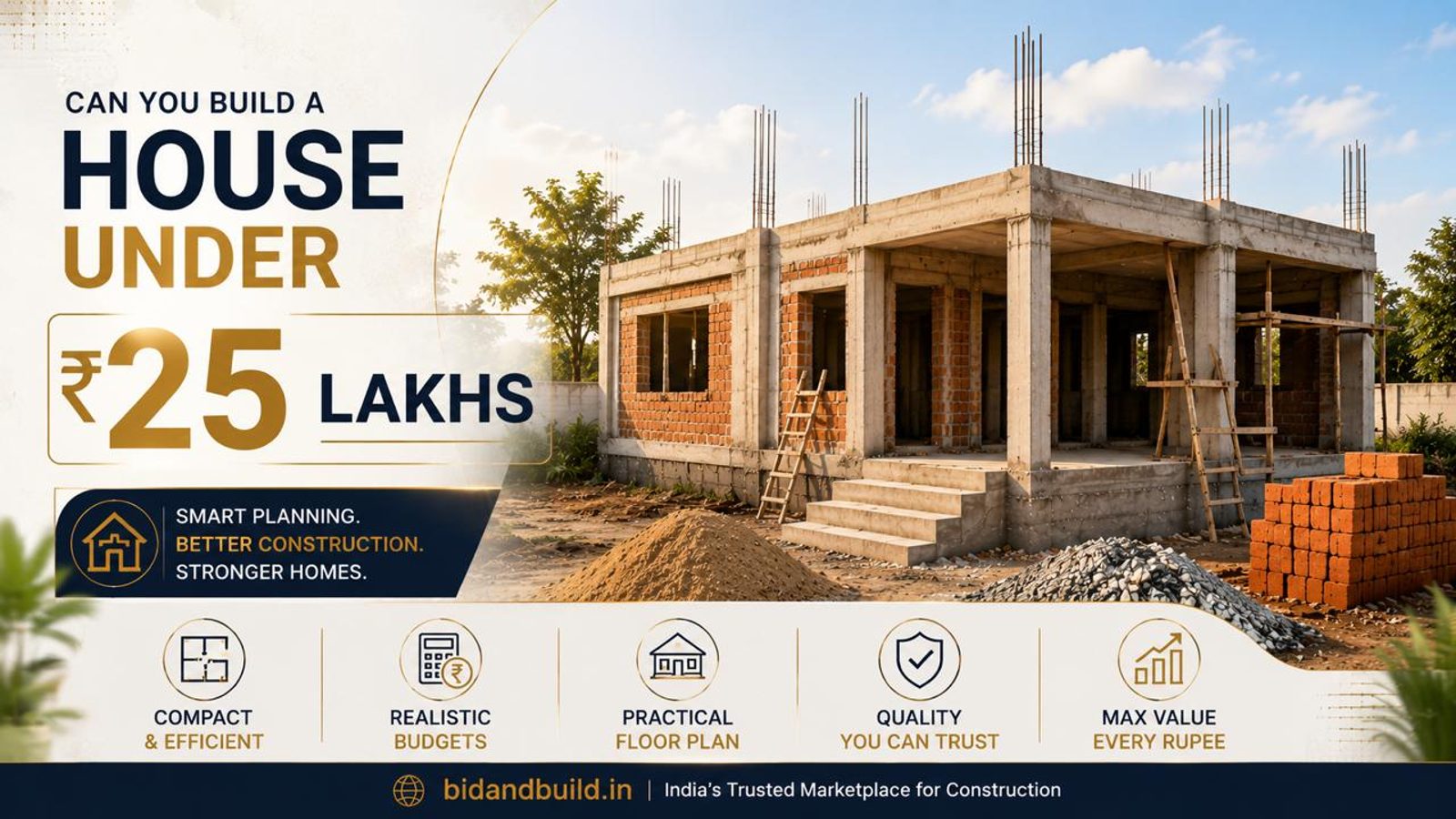
Quick answer: Yes — A compact, efficiently designed house of 800–1,000 sq ft can be built under ₹25 lakhs in most Tier 2 and Tier 3 Indian cities in 2026, excluding land. The tradeoff is footprint, not safety: you get a smaller, simpler home rather than a compromised one, provided the structure and foundation are never where you cut costs.
If you're working with a ₹25 lakh budget, you've probably already noticed that most online cost guides assume a much bigger home. That's not your fault — it's because ₹25 lakhs is a genuinely tight number, and getting it right requires sharper decisions than a ₹40 or ₹50 lakh build does.
The honest answer is: it's possible, but only if you accept a smaller footprint and resist the temptation to add rooms "just in case." This guide shows exactly what ₹25 lakhs actually buys, where the money goes, and the specific decisions that keep you inside the number.
→ Before hiring anyone, compare architects and contractors on bidandbuild.in — free, no obligation.
New to BidandBuild? Read What is BidandBuild? India's Trusted Marketplace to see how it works.
What Size House Can ₹25 Lakhs Actually Build ?
Your built-up area is the single biggest lever on your final cost, more than city or finish quality.
| Plot Size | Realistic Built-Up Area | Estimated Cost |
|---|---|---|
| 15 × 30 ft | 700–850 sq ft | ₹18–23 lakh |
| 20 × 30 ft | 850–1,000 sq ft | ₹22–26 lakh |
| 20 × 40 ft | 1,000–1,150 sq ft | ₹25–30 lakh |
A 20×30 ft plot, built to roughly 900–1,000 sq ft, gives the best balance for a ₹25 lakh budget — enough for a functional 2BHK without pushing past the number. Anything larger than 1,000 sq ft starts to strain this budget unless finishes are kept very basic.
Keep a 10% contingency buffer in mind even at this budget level. For a ₹25 lakh project, that means setting aside ₹2.5 lakh separately for price escalation or small design adjustments — skipping this is the single most common regret homeowners report after the fact.
Construction Cost Per Sq Ft in India — City-Wise (2026)
| City | Construction Cost per Sq Ft |
|---|---|
| Patna | ₹1,600–₹1,900 |
| Bhopal | ₹1,600–₹1,900 |
| Indore | ₹1,700–₹2,000 |
| Jaipur | ₹1,800–₹2,100 |
| Nagpur | ₹1,700–₹2,000 |
| Lucknow | ₹1,700–₹2,000 |
| Hyderabad / Pune | ₹2,000–₹2,400 |
| Bangalore | ₹2,200–₹2,600 |
| Delhi / NCR | ₹2,200–₹2,800 |
| Mumbai | ₹2,600–₹3,200+ |
At basic-to-standard finish, Tier 2 and Tier 3 cities like Patna, Bhopal, Indore, and Nagpur make ₹25 lakhs realistic for a 900-1,000 sq ft home. In metros, the same budget caps your footprint closer to 700-800 sq ft, or requires a noticeably more basic finish level.
If you're building in Patna specifically, our detailed Patna construction cost breakdown covers locality-by-locality rates and a budget formula you can apply directly to this number. Looking to hire locally instead? See our guides on Top 10 Architects in Patna 2026 and Best Architects in Indore 2026.
A Functional Floor Plan Under ₹25 Lakhs
A well-planned 900 sq ft home on a 20×30 plot typically looks like this:
Single Floor — Living-cum-dining area, kitchen, two bedrooms, one common bathroom, small entry porch.
This layout covers what most small families actually need, without rooms added purely for appearance. A separate dining room, a guest bedroom used twice a year, or an oversized living room each add ₹1–2 lakhs that a ₹25 lakh budget genuinely cannot absorb.
Vastu note: for east or north-facing plots, this compact layout still allows correct entrance and kitchen orientation without needing extra space. Confirm orientation with your architect at the design stage, since correcting it after the foundation is poured is far more expensive than planning it correctly the first time.
If you have a little more flexibility and are weighing a duplex instead of a single floor, our guide on trending duplex house styles in India shows what that looks like at a higher budget tier.
Where Your ₹25 Lakhs Actually Goes ?
| Component | Estimated Cost |
|---|---|
| Foundation & Structure | ₹8–9 lakh |
| Brickwork & Plaster | ₹3–4 lakh |
| Electrical & Plumbing | ₹2–2.5 lakh |
| Flooring & Tiles | ₹2–2.5 lakh |
| Doors & Windows | ₹1.5–2 lakh |
| Paint & Finishing | ₹1.5–2 lakh |
| Miscellaneous | ₹2–3 lakh |
| Total | ₹21–25 lakh |
Foundation and structure alone consume roughly 35% of this budget, the same proportion as in larger builds — this is never the place to economize, since it's the one component that affects long-term safety. Save instead on flooring grade, paint brand, and door/window sizing, where standard choices look nearly identical to premium ones at a fraction of the cost. Cement, steel, and flooring together account for a large share of even this smaller budget, so comparing rates from a few verified material suppliers before bulk-purchasing can meaningfully protect a tight number like this one.
6 Ways to Actually Stay Under ₹25 Lakhs
- Keep the design genuinely simple. A flat-roof, rectangular structure with no curves or projections is the single biggest cost-saver available at this budget — decorative elevation elements can add ₹1–2 lakhs that a tighter budget cannot spare.
- Resist adding a room "just in case." Every additional room adds ₹1–2 lakhs in structure, flooring, electrical, and finishing combined — at ₹25 lakhs, this is the most common way homeowners blow past their number.
- Use standard room dimensions. Rooms sized at common dimensions like 10×10 or 10×12 use standard material lengths efficiently, while odd dimensions create cutting waste that gets billed to you.
- Compare at least three contractor quotes. Even at this budget level, quotes for identical scope can vary by ₹2–4 lakhs between contractors — that gap alone can be the difference between staying under ₹25 lakhs and going over.
- Choose load-bearing construction over a full RCC frame, where your engineer confirms it's structurally appropriate for a single-floor home. This can reduce structural cost by 10–15% without compromising safety on a genuinely single-storey build.
- Finalise your design completely before construction starts. A single mid-construction change — a different door size, a shifted wall — costs several times more to execute once work has begun than it would have cost on paper. This is one of the most common reasons budgets fail across all project sizes, not just smaller ones — our guide on why India's home renovation projects fail covers the same pattern in detail.
Why a ₹25 Lakh Build Needs an Architect Even More, Not Less ?
It's tempting to skip architect fees at a tight budget to save the ₹20,000–₹50,000 they typically charge for a project this size. In practice, a tighter budget is exactly where good design judgment matters most — an architect who plans your 900 sq ft efficiently can be the difference between a home that feels complete and one that feels cramped.
A poorly planned compact home is also harder to get bank approval for, since lenders want to see proper drawings before releasing a construction loan. The fee saved by skipping an architect is rarely a real saving once these costs are accounted for.
For a complete walkthrough of how to evaluate and hire the right professional for a budget-conscious build, read how to hire an architect, contractor, or interior designer in India.
→ Find verified architects, contractors, and material suppliers in your city, compare portfolios, and book a free consultation at bidandbuild.in.
₹25 Lakhs vs ₹40 Lakhs — What the Extra ₹15 Lakhs Actually Buys ?
| Feature | ₹25 Lakh Budget | ₹40 Lakh Budget |
|---|---|---|
| Built-up Area | 800–1,000 sq ft | 1,400–1,800 sq ft |
| Floors | Single Floor | Duplex (G+1) |
| Elevation | Simple, Flat | Simple to Moderate Detailing |
| Flooring | Standard Vitrified | Standard to Better Vitrified |
| Contingency Room | Tight | Comfortable |
A ₹25 lakh home is not a lesser version of a ₹40 lakh home — it's a different category of project, built for a smaller family or a smaller plot. The homeowners who succeed at this budget are the ones who plan for exactly what they need, not what they wish they had. For a full breakdown of what the next budget tier unlocks, see our guide on building a duplex house under ₹40 lakhs, or our complete step-by-step guide to building a house in India for the full process regardless of budget tier.
Build Smarter — Compare Before You Hire
The homeowners who stay within a ₹25 lakh budget are not lucky — they compare architects, get multiple contractor quotes, fix their design before construction begins, and resist scope creep at every stage.
BidandBuild makes that comparison free and easy — verified architects, contractors, civil engineers, and material suppliers in your city, with real reviews and portfolios you can see before a single conversation. There's zero commission charged to homeowners, ever.
→ Start at bidandbuild.in — free signup, no money needed.
Frequently Asked Questions
1. Can you build a house under ₹25 lakhs in India in 2026 ?
Yes, a compact 800–1,000 sq ft home can be built under ₹25 lakhs in most Tier 2 and Tier 3 cities, provided the design is simple and finishes are kept basic to standard. In metro cities, the same budget typically caps the footprint closer to 700–800 sq ft.
2. What size house can I build with ₹25 lakhs ?
Most homeowners can build between 800 and 1,000 sq ft within a ₹25 lakh budget, depending on city and finish level. A 20×30 ft plot offers the best balance of space and cost at this budget.
3. Is ₹25 lakhs enough for a 2BHK house ?
Yes, a compact 2BHK with a living-dining area fits comfortably within a ₹25 lakh budget in most Tier 2 and Tier 3 cities. The layout needs to stay efficient, without rooms added purely for appearance.
4. What should never be compromised in a ₹25 lakh build ?
Foundation and structural steel should never be where costs are cut, since this directly affects the safety and longevity of the home. Savings should instead come from flooring grade, paint brand, and finishing choices.
5. Should I hire an architect for a ₹25 lakh house ?
Yes, an architect is especially valuable at tighter budgets, since efficient space planning matters more when there's less room to work with. Their fee is typically recovered through reduced material wastage and a design that avoids costly mistakes.
6. How do I get an accurate cost estimate for my specific city ?
Online guides provide realistic ranges, but exact rates depend on your city's local material and labour costs. Comparing multiple quotes from verified contractors and material suppliers on BidandBuild gives the most accurate picture before committing to anyone.