Building Plan Approval in Jaipur 2026: JDA BPAS Process, Fees & Heritage Zone Rules
By BidandBuild Editorial Team — Reviewed by Ar.Satyam Kumawat, B.Arch (MNIT Jaipur) · 2026-07-26
Building plan approval in Jaipur goes through Rajasthan's BPAS portal in 2026 — JDA for planned areas, JMC for core city. Real fees, Heritage Zone rules, step-by-step process, and verified architects — free on BidandBuild.
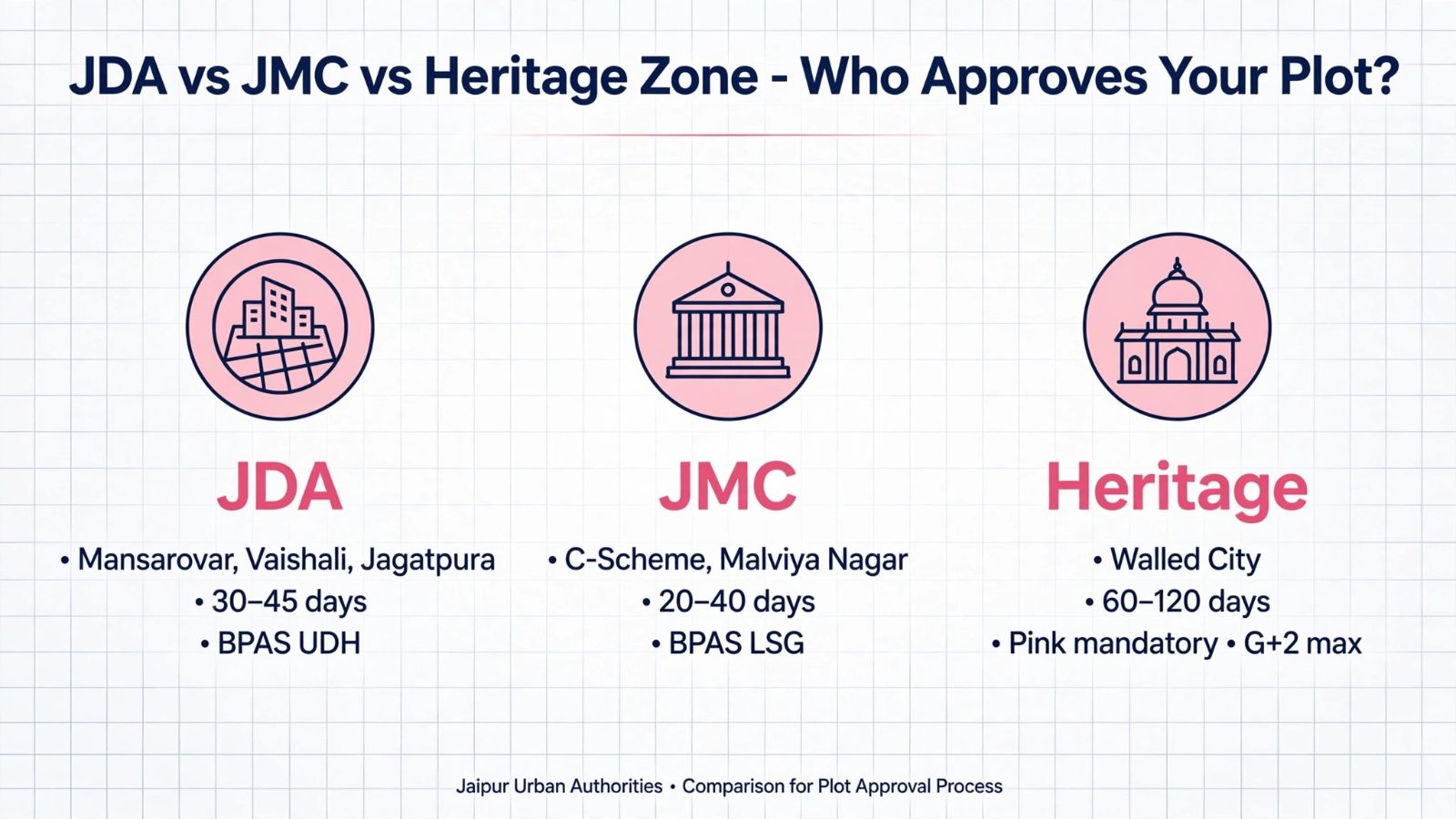
Quick answer: Building plan approval in Jaipur in 2026 goes through Rajasthan's BPAS (Building Plan Approval System) portal, accessed via Rajasthan SSO login. JDA (Jaipur Development Authority) handles planned areas and peri-urban zones in 30–45 days. JMC (Jaipur Municipal Corporation) handles core city plots in 20–40 days. The Heritage Zone (Walled City) requires a separate heritage committee approval adding 60–120 days and carries strict rules on facade colour, height, and architectural style. JDA approval fees range from ₹15,000 to ₹80,000 depending on plot size.
Every year, Jaipur homeowners start construction without a sanctioned plan — assuming the process is slow, expensive, or unnecessary for a small home. The consequences are predictable: stop-work notices, inability to get a completion certificate, no permanent electricity or water connection, and legal complications at resale. The approval process, done correctly with the right architect, takes 20–45 days and protects every rupee of your construction investment.
This guide covers exactly what the process involves, what makes Jaipur's market genuinely different from other cities, how much it actually costs, and where most applications go wrong.
This is the most common cause of delays in Jaipur. The city has two different approving authorities, and submitting to the wrong one means starting over.
Core city wards — Malviya Nagar, C-Scheme, Bani Park, Civil Lines
BPAS (LSG) via Rajasthan SSO
Heritage Committee
Walled City (Old Jaipur) — Chandpole, Johari Bazaar, Tripolia, Kishanpole
Additional permission beyond JDA/JMC
JDA=Jaipur Development Authority JMC= Jaipur Municipal Corporation
Both portals use the same Rajasthan SSO login at sso.rajasthan.gov.in — but you select either "BPAS (UDH)" for JDA areas or "BPAS (LSG)" for JMC/local body areas after login. Selecting the wrong one at submission means rejection and restarting.
Confirm your plot's jurisdiction from your allotment letter or property registry before briefing any architect. When in doubt, check at the JDA helpdesk at JLN Marg or call the JDA Town Planning division.
These are not in most building approval guides. Each one directly affects your timeline, cost, and design.
Fact 1: Jaipur Is Seismic Zone II — Good News for Your Budget
Unlike Patna (Zone IV) or Delhi (Zone IV), Jaipur falls under Seismic Zone II — the lowest risk classification in India. This has a real, direct impact on your costs:
Standard IS 456 structural design is sufficient — no Fe500D ductile detailing required
No mandatory separate structural engineer certificate for standard residential projects
Foundation and column design is significantly simpler and cheaper than in high-seismic cities
IS 1893 seismic provisions apply but Zone II requirements are the least stringent nationally
For a 1,500 sq ft home, this typically saves ₹15,000–₹40,000 in structural engineering costs compared to building the same home in Patna or Delhi. Most homeowners never hear this from their contractor — it's worth knowing.
Fact 2: The Heritage Zone Changes Everything
Jaipur's Walled City is a UNESCO World Heritage Site. Any construction or renovation within this boundary — Chandpole, Johari Bazaar, Tripolia Bazaar, Kishanpole, and surrounding areas — is subject to rules that override standard JDA norms entirely:
Mandatory pink facade — all exterior surfaces must use Jaipur's traditional pink/rose-ochre colour
Height restriction — generally G+2 maximum, regardless of plot size
Traditional architectural elements — jali screens, chajjas, and traditional proportions required
Heritage committee approval — a separate approval layer on top of JDA/JMC that adds 60–120 days
If your plot is anywhere near the Walled City boundary, confirm heritage zone status before purchasing land and before designing anything. Heritage zone restrictions affect resale value, rental yield, and construction cost in ways that significantly change the economics of a project.
Fact 3: Rajasthan's Climate Rules Affect Your Design
Jaipur's construction bye-laws under the Rajasthan Unified Building Bye-Laws 2020 embed climate-responsive requirements that are stricter than most states. Specifically:
Thick walls (12–14 inch) or cavity walls with insulation are expected for thermal comfort
Minimum chajja (overhang) depth of 3–4 feet on south and west facades
Cool roof or reflective coating requirements for terrace slabs in new construction
Double-glazed or reflective windows on west-facing walls are strongly recommended
These measures add ₹100–₹180 per sq ft to construction cost but reduce air conditioning costs by 40–50% over the building's life. An architect who designs Jaipur homes routinely will include these automatically. One who doesn't will produce a building that's expensive to cool for the next 30 years.
How the BPAS Portal Works in 2026
BPAS is Rajasthan's online building plan approval system — the state's equivalent of Bihar's AutoMap. All JDA and JMC applications are submitted, tracked, and approved here. No physical file submission for standard residential projects.
The step-by-step login process:
Create or login to your Rajasthan SSO ID at sso.rajasthan.gov.in
After login, select "BPAS (UDH)" for JDA areas or "BPAS (LSG)" for JMC areas from Citizen Apps
Search "BPAS" in the quick search bar and click the BPAS portal
Click "NEW APPLICATION" and follow the form with your plot and owner details
Upload all documents and drawings
Click PAY NOW to submit scrutiny fee and receive acknowledgement
Your architect typically handles steps 2 through 6 — but knowing the login flow helps you track your own application and follow up directly if needed.
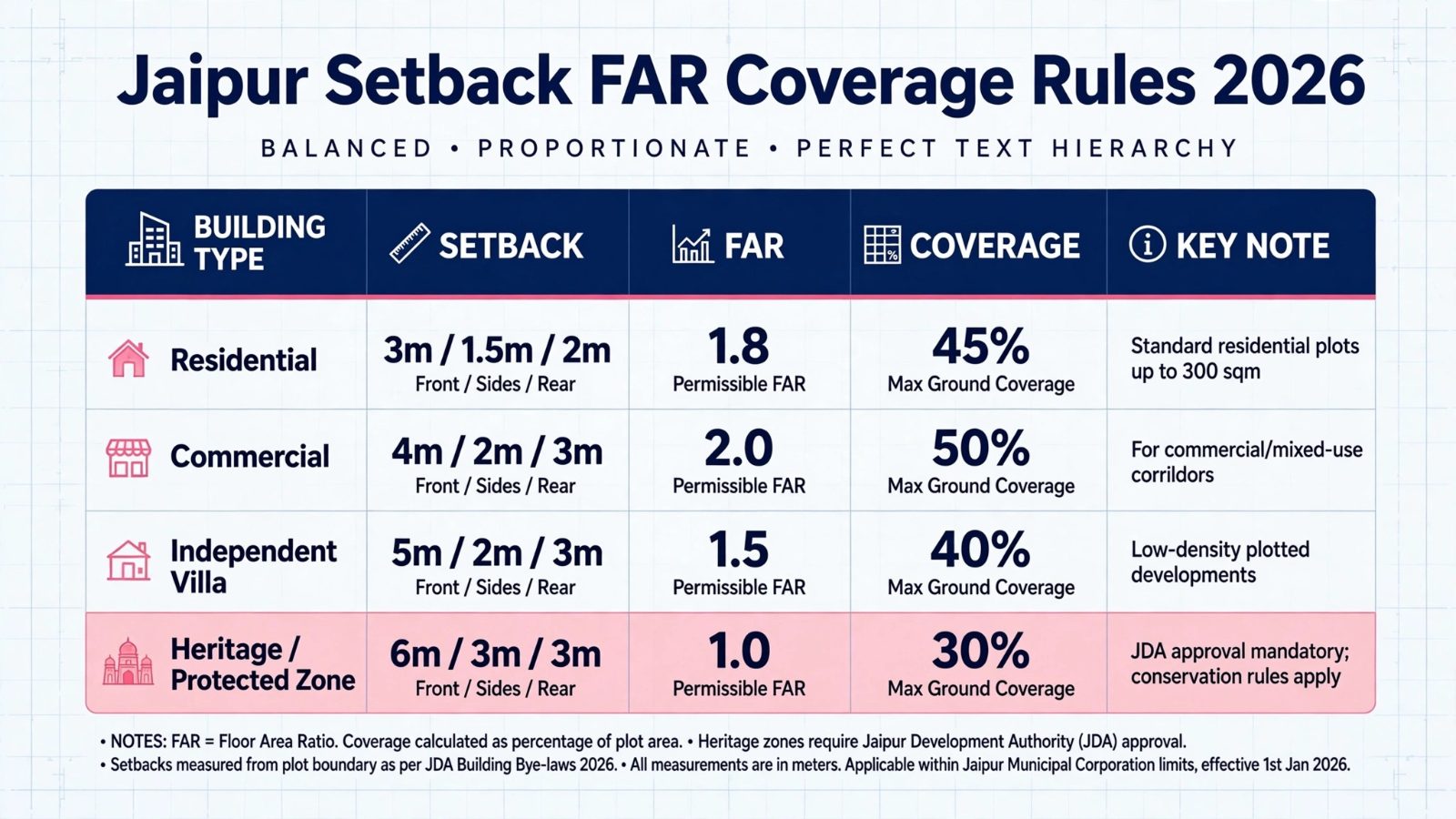
JDA Setback and FAR Rules — Rajasthan Unified Building Bye-Laws 2020
Most BPAS rejections happen because drawings don't comply with these rules. Your architect must lock these constraints before the first sketch — not adjust for them at the drawing stage.
For plots up to 100 sq m:
Rule
Requirement
Front setback
2 m minimum
Side and rear
1.5 m
Ground coverage
70% max
FAR
1.5
Max height
G+1 typically
For plots 100–300 sq m:
Rule
Requirement
Front setback
3 m
Rear setback
2 m
One side
2 m
Ground coverage
60% max
FAR
1.5–2.0
Max height
G+2
For plots 300–500 sq m:
Rule
Requirement
Front setback
4 m
Rear and sides
3 m each
Ground coverage
50% max
FAR
2.0–2.5
Max height
G+3
Heritage Zone: All above norms are overridden. Maximum G+2 applies regardless of plot size. Pink facade is mandatory. Heritage committee signs off separately.
Documents Required for JDA/JMC Approval
Mandatory for all projects:
Document
Note
Property registry or allotment letter
Must match revenue records exactly
Khasra / Khatauni (revenue record)
Updated, with JDA/JMC zone marking visible
COA-registered architect certificate
Licensed architect must sign all drawings
Architectural drawings
Floor plans, elevations, sections, site plan
Structural drawings
Required for G+2 and above — by licensed structural engineer
Site plan with JDA/JMC zone marking
Confirms jurisdiction before scrutiny
Required in specific cases:
Document
When Required
Fire NOC
G+3 and above or above 15m height
Heritage committee NOC
Any work in Walled City heritage zone
Airport NOC
Plots under Jaipur International Airport flight path
RIICO NOC
Industrial zone adjacent plots
Step-by-Step JDA Approval Process via BPAS (2026)
Confirm jurisdiction — plot's allotment letter confirms JDA or JMC authority. Never assume.
Hire a COA-registered architect — only a licensed architect can sign and submit BPAS drawings.
Site and revenue record verification — architect verifies plot in BPAS database, confirms zone, applicable FAR, and setback rules.
Drawing preparation — architectural and structural drawings prepared per Rajasthan Unified Building Bye-Laws 2020. Typically 7–14 days.
BPAS portal submission — login via Rajasthan SSO, upload all documents and drawings, pay scrutiny fee.
Most standard approvals — experienced architect pool
Malviya Nagar / C-Scheme
JMC
Core city — faster JMC timeline
Civil Lines / Bani Park
JMC
Premium zones — scrutiny more thorough
Kalwar Road / Jagatpura
JDA
Growing zones — newer colony approvals
Muhana / Sanganer
JDA
Peripheral — confirm exact jurisdiction from allotment
Tonk Road / Sitapura
JDA/RIICO
Industrial-adjacent — check RIICO NOC requirement
Walled City / Old Jaipur
JDA + Heritage Committee
Mandatory pink facade, G+2 max, 60–120 days extra
Top 5 Rejection Reasons in Jaipur — and How to Avoid Each
Wrong authority submission — JDA vs JMC confusion is the single most common cause of restarts. Confirm jurisdiction from allotment letter before submitting.
Heritage zone non-compliance — submitting a non-pink facade design for a Walled City plot. Heritage committee rejects at the first review stage with no partial credit.
Revenue record mismatch — name on property registry must match khasra/khatauni exactly. A single spelling difference causes rejection.
Missing G+2 structural drawings — structural engineer's signed drawings are required for G+2 and above. Many homeowners discover this only after submitting without them.
After Approval: 4 Steps That Complete Legal Construction
Completion Certificate / OC — JDA/JMC issues on inspection
Why the Completion Certificate matters in Jaipur: it is required for permanent JVVNL electricity connection, PHED water supply, final home loan disbursement, and legal resale. Properties without CC/OC in Jaipur sell at a significant discount — buyers cannot secure home loans against unapproved buildings, and Jaipur's real estate market is active enough that buyers routinely verify approval status before making offers.
Rajasthan Stamp Duty: The Cost Before Construction
Buyer
Stamp Duty
Registration
Surcharge
Total
Male
6%
1%
23% surcharge on stamp duty
~8.4% effective
Female
5%
1%
23% surcharge on stamp duty
~7.2% effective
Joint
5%
1%
23% surcharge on stamp duty
~7.2% effective
On a ₹50 lakh plot — approximately ₹3.6–₹4.2 lakh in stamp duty and registration. Budget this completely separately from construction and approval costs.
5-Step Checklist Before Hiring a Jaipur Architect
Confirm JDA or JMC jurisdiction — from allotment letter or property registry. Never assume based on neighbourhood name alone.
Confirm heritage zone status — if anywhere near the Walled City, check before any design work begins. Heritage rules override all standard JDA norms.
Verify COA registration — at coaonline.org. Ask for the registration number upfront.
Ask specifically about BPAS experience — "How many applications have you submitted and cleared on BPAS for JDA/JMC specifically?" This separates architects with real portal experience from those learning on your project.
Get 3 itemised quotes — architectural design fee, structural engineering fee, BPAS liaisoning, and heritage committee submission (if applicable) must all be listed separately before you sign anything.
BidandBuild is the fastest way to reach homeowners actively planning projects in Jaipur, Ajmer, Jodhpur, Kota, and across Rajasthan — with zero commission and a free verified profile. Join BidandBuild as a professional — free
Post your cement, steel, tiles, Rajasthan stone, or electrical requirements on BidandBuild. Verified material suppliers in Jaipur respond with competing quotes at zero commission.
1.What is the building plan approval process in Jaipur?
Building plan approval in Jaipur goes through Rajasthan's BPAS portal via Rajasthan SSO login. JDA handles planned areas and peri-urban zones (BPAS UDH), JMC handles core city wards (BPAS LSG). A COA-registered architect submits drawings and documents online. JDA approvals take 30–45 days, JMC takes 20–40 days, and Heritage Zone projects require an additional 60–120 days for heritage committee approval.
2. How much does JDA building plan approval cost in Jaipur?
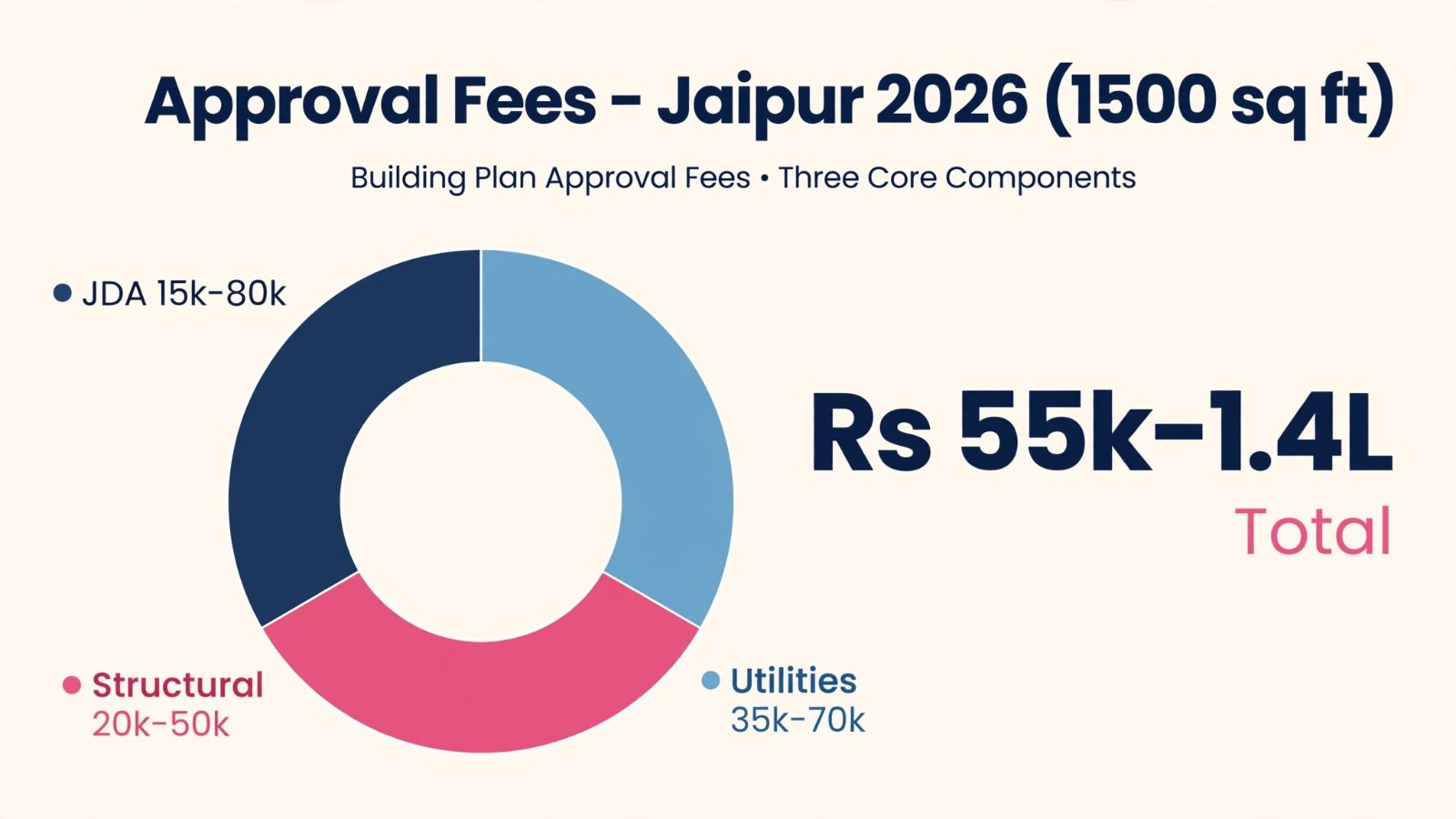
JDA approval fees range from ₹15,000 to ₹80,000 depending on plot size. Add structural engineering certification (₹20,000–₹50,000) and utility connections (₹35,000–₹70,000) for a total of ₹55,000–₹1,40,000 for a standard residential project. Heritage Zone projects carry an additional fee of approximately ₹25–₹50 per sq ft.
3. What is the Heritage Zone rule for Jaipur construction?
The Walled City of Jaipur is a UNESCO World Heritage Site. Construction within this boundary requires mandatory pink/rose-ochre facade, maximum G+2 height regardless of plot size, traditional architectural elements (jali, chajja), and a separate heritage committee approval adding 60–120 days. These rules cannot be waived or negotiated.
4. Do I need a structural engineer for JDA approval in Jaipur?
Structural engineer drawings signed by a licensed engineer are required for G+2 and above construction. For G+1 and below, standard architectural drawings are sufficient in most cases. Jaipur's Seismic Zone II classification means standard IS 456 design applies — no ductile detailing or Fe500D steel requirement as in Zone IV cities.
5. What is the difference between JDA and JMC approval in Jaipur?
JDA (Jaipur Development Authority) covers planned sectors, JDA schemes, and peri-urban areas — Mansarovar, Vaishali Nagar, Kalwar Road, Jagatpura. JMC (Jaipur Municipal Corporation) covers core city wards — Malviya Nagar, C-Scheme, Civil Lines, Bani Park. Both use the BPAS portal but select different modules (UDH vs LSG). Wrong selection means rejection and restarting.
6. Is Jaipur in a high-risk seismic zone?
No. Jaipur is Seismic Zone II — the lowest risk classification in India. Standard IS 456 structural design is sufficient. This is significantly different from cities like Patna, Delhi, or Guwahati (all Zone IV or V) where ductile detailing and higher steel specifications are mandatory.
7. How long does building plan approval take in Jaipur?
JDA approval takes 30–45 days when submitted correctly via BPAS. JMC approval takes 20–40 days. Heritage Zone projects require an additional 60–120 days for heritage committee review. The most common delay cause: wrong authority submitted to, or heritage zone compliance issues discovered at scrutiny.
8. What documents are needed for JDA approval in Jaipur?
Property registry or allotment letter, khasra/khatauni revenue record with JDA/JMC zone marking, COA architect certificate, architectural drawings, structural drawings (G+2 and above), and site plan. Additionally: Fire NOC (G+3+), Heritage NOC (Walled City), Airport NOC (flight path plots), RIICO NOC (industrial-adjacent plots).
9. Can I build without JDA approval in Jaipur?
No. Unauthorized construction in Jaipur results in stop-work notices, penalties, no permanent electricity or water connection, and inability to sell legally. In the Walled City, demolition orders for unauthorized construction are actively enforced given UNESCO heritage monitoring. Do not begin construction without a sanctioned plan.
10. What is BidandBuild and how does it help Jaipur homeowners?
BidandBuild is India's construction marketplace connecting homeowners with verified COA-registered architects, contractors, interior designers, and material suppliers — completely free for homeowners, zero commission. Jaipur homeowners post their project, receive competing quotes from BPAS-experienced verified architects, and hire with confidence. Learn more.
Ready to start your building approval in Jaipur? Post your project once. Get 3 verified quotes from JDA-empanelled architects. Free. Zero commission. No middlemen.→ Post your project free on bidandbuild.in